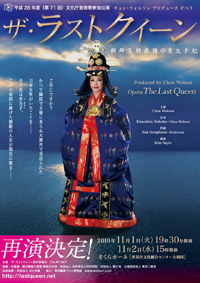
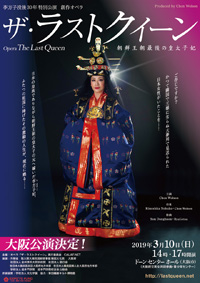
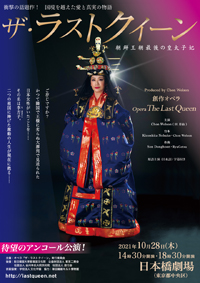
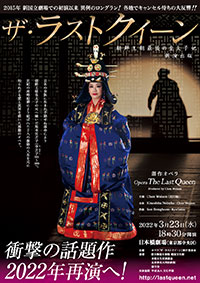
日韓両国で絶賛を博した
歴史的舞台の 最後の東京公演
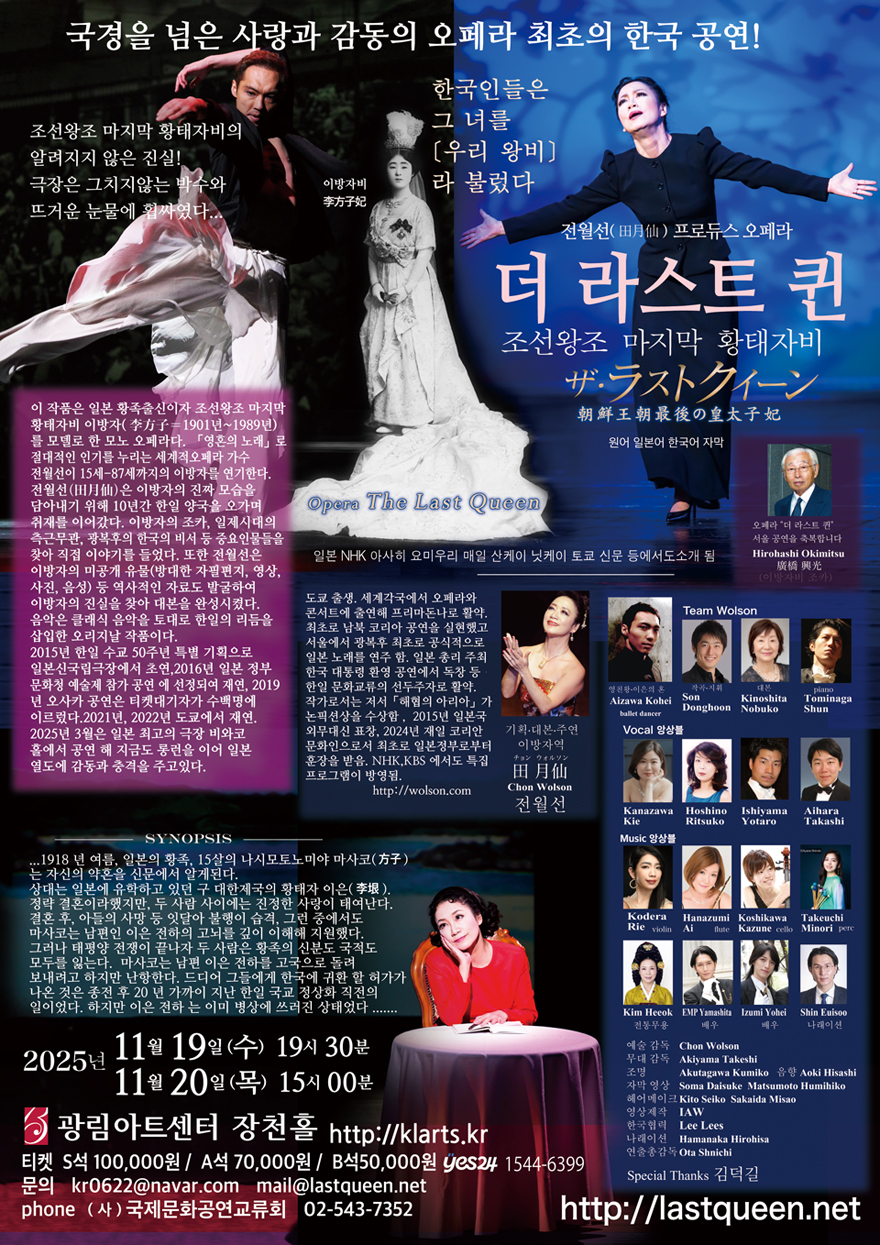
オリジナルメンバーによる最終幕

チョン・ウォルソン プロデュース公演

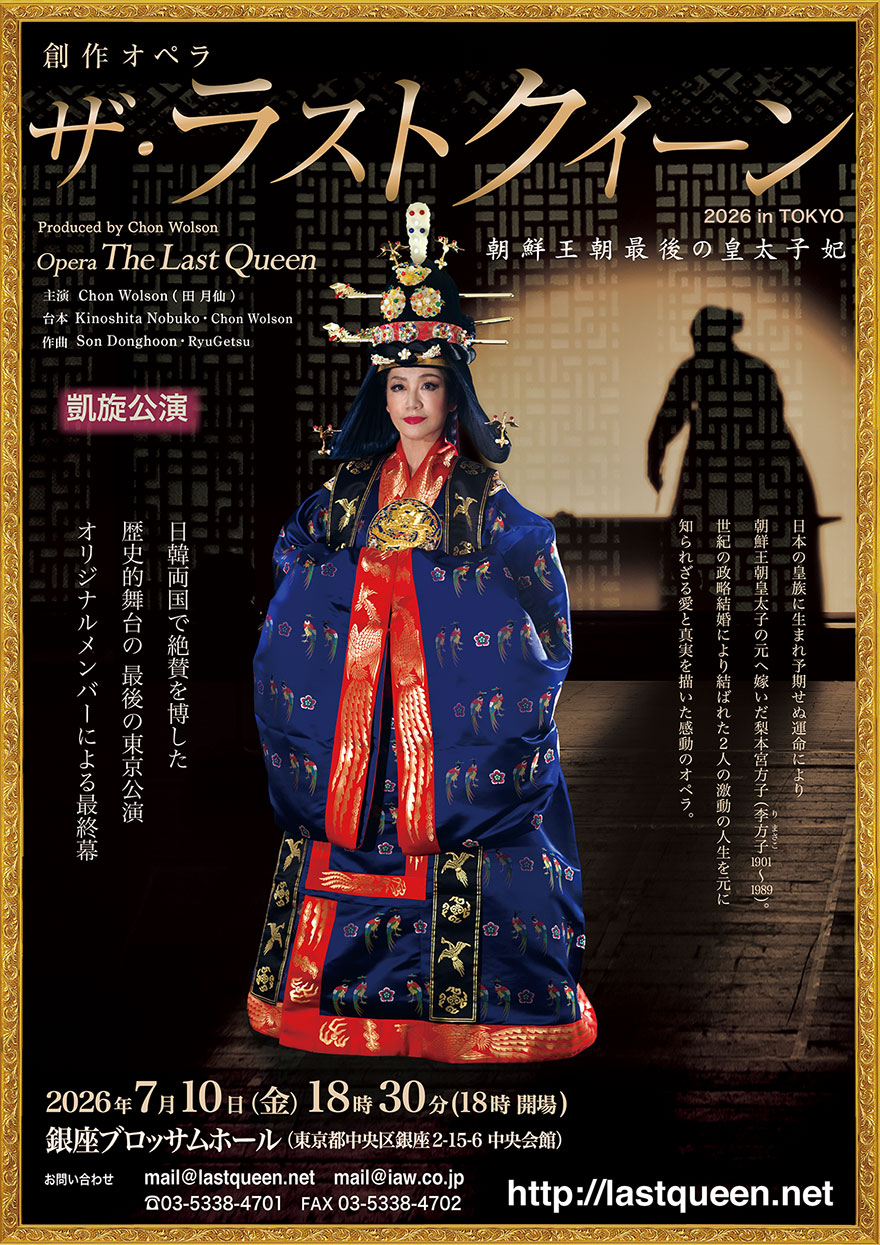
創作オペラ ザ・ラストクィーン

2026 in TOKYO

朝鮮王朝最後の皇太子妃 

2026年710日(金曜日)18:30

銀座ブロッサムホール(東京都中央区銀座2-15-6)

2015年新国立劇場での初演以来 異例のロングラン
各地でキャンセル待ちの大反響!!
予告映像


日本の皇族に生まれ 予期せぬ運命により
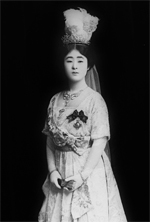
朝鮮王朝皇太子の元へ嫁いだ梨本宮方子(李方子1901〜1989)。
世紀の政略結婚により結ばれた2人の激動の人生を元に
知られざる愛と真実を描いた感動のオペラ。

すべての公演が満席となった
衝撃の話題作オペラ「ザ・ラストクイーン」
ついに最終章へ!

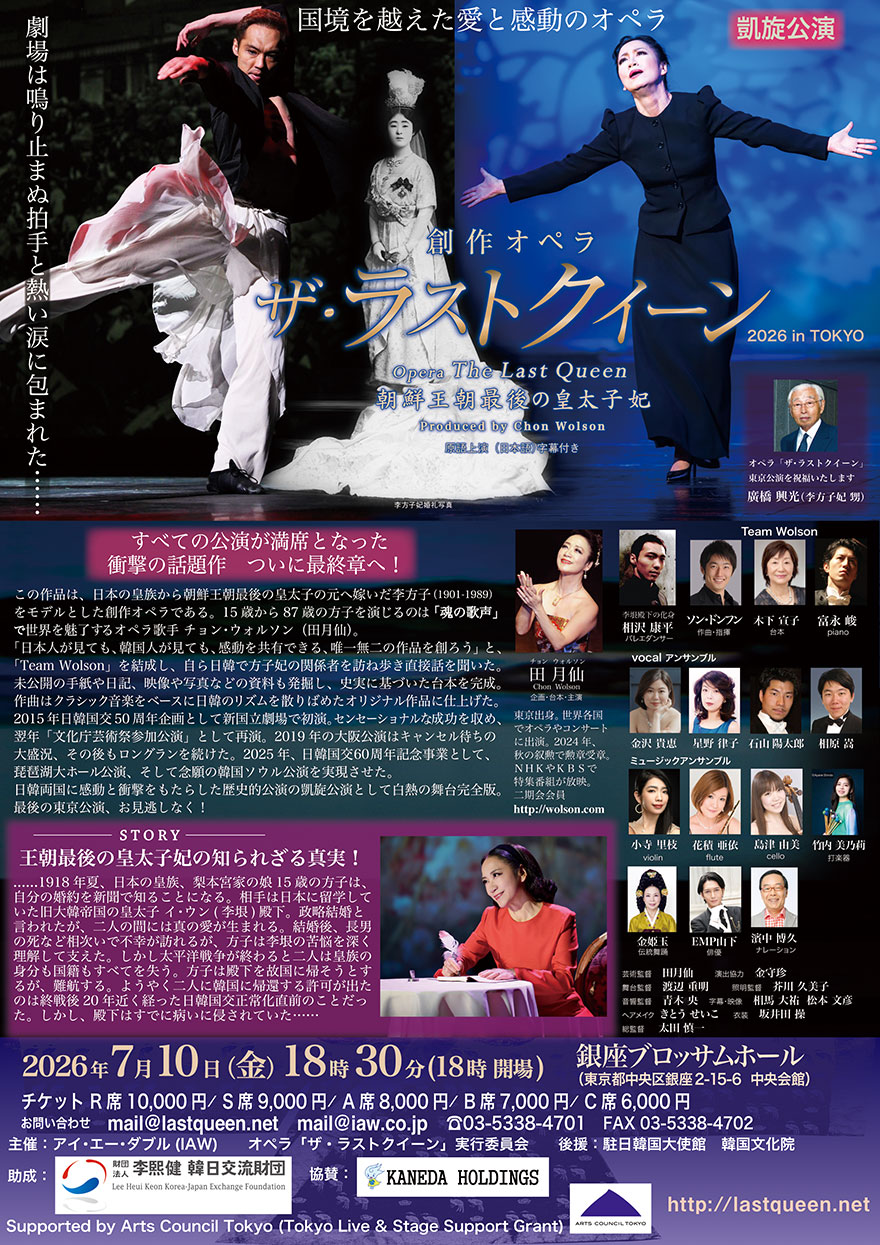
この作品は、日本の皇族から朝鮮王朝最後の皇太子の元へ嫁いだ李方子(1901-1989)をモデルとした創作オペラである。15歳から87歳の方子を演じるのは「魂の歌声」で世界を魅了するオペラ歌手 チョン・ウォルソン(田月仙)。
「日本人が見ても、韓国人が見ても、感動を共有できる、唯一無二の作品を創ろう」と、「Team Wolson」を結成し、自ら日韓で方子妃の関係者を訪ね歩き直接話を聞いた。未公開の手紙や日記、映像や写真などの資料も発掘し、史実に基づいた台本を完成。作曲はクラシック音楽をベースに日韓のリズムを散りばめたオリジナル作品に仕上げた。
2015年日韓国交50周年企画として新国立劇場で初演。センセーショナルな成功を収め、翌年「文化庁芸術祭参加公演」として再演。2019年の大阪公演はキャンセル待ちの大盛況、その後もロングランを続けた。2025年、日韓国交60周年記念事業として、
琵琶湖大ホール公演、そして念願の韓国ソウル公演を実現させた。
日韓両国に感動と衝撃をもたらした歴史的公演の凱旋公演として白熱の舞台完全版。
最後の東京公演、お見逃しなく!


あらすじ

 ......1918年夏、日本の皇族、梨本宮家の娘15歳の方子は、自分の婚約を新聞で知ることになる。相手は日本に留学していた旧大韓帝国の皇太子 イ・ウン(李垠)殿下。政略結婚と言われたが、二人の間には真の愛が生まれる。結婚後、長男の死など相次いで不幸が訪れるが、方子は李垠の苦悩を深く理解して支えた。しかし太平洋戦争が終わると二人は皇族の身分も国籍もすべてを失う。方子は殿下を故国に帰そうとするが、難航する。ようやく二人に韓国に帰還する許可が出たのは終戦後20年近く経った日韓国交正常化直前のことだった。しかし、殿下はすでに病いに侵されていた……


オペラ「ザ・ラストクィーン」の上演を祝福いたします


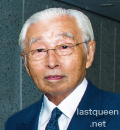
廣橋興光
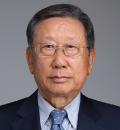
李 源
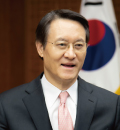
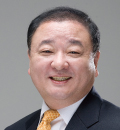
李 公宰

(李方子妃 甥)
(全州李氏大同宗約院 総裁/皇嗣孫)
(李方子妃 元秘書)


わたしの大切なふたつの祖国 
たがいの母なる国よ 幸あれ。ともに、永遠(とわ)に……
 

企画・主演(李方子役)

チョン・ウォルソン
田月仙
Chon Wolson

전월선

ソプラノ 二期会会員

Soprano Members of Nikikai


「ザ・ラストクィーン 朝鮮王朝最後の皇太子妃」
公演 おめでとうございます 

李方子妃 甥

廣橋 興光

(廣橋興光。広橋興光 廣橋家当主)

伯母、李方子をモデルとしたオペラ「ザ・ラストクィーン」。2015年10月の東京・新国立劇場での初演、2016年東京での文化庁芸術祭参加の再演、2019年の大阪公演、2021年2022年東京公演とも数多くの観客の皆様と共に、白熱した舞台を観る事ができまして、感動いたしました。
日本と韓国の架け橋として活動されてきた田月仙さんほか、御共演者、ご関係者の皆様方へ感謝いたします。公演のご成功を心よりお祈りいたします


オペラ「ザ・ラストクイーン
〜朝鮮王朝最後の皇太子妃〜」の開催を心よりお祝い申し上げます
 
  外務大臣
駐日本国大韓民国特命全権大使
駐日本国大韓民国特命全権大使
駐日本国大韓民国特命全権大使
駐日本国大韓民国特命全権大使
駐日本国大韓民国特命全権大使
  岸田 文雄 柳興洙 李 俊揆 李洙勲 姜昌一 朴喆煕


音楽評論家 関根礼子

「ソプラノ歌手チョン・ウォルソン(田月仙)制作・主演のオペラ≪ザ・ラストクィーン≫を昨年の初演に続き2度目の観劇。大正時代に朝鮮の皇太子に嫁いだ日本人女性の生涯を描いた内容で、その人生には、観るたびに大きな衝撃を受ける。政府間では解決困難なことも多い日韓関係だが、個人レベルや民間同士なら友好関係も築ける。このオペラはその一石になるだろう。」


音楽評論家 三善清達 (「音楽の友」より)

企画、主演は在日コリアン2世のソプラノ田月仙(チョン・ウォルソン)で、10年の構想、取材をかけた彼女の熱意によって生まれた作品だ。主演の田月仙は衣装を替えながら、15歳から87歳までを演じたが、特に朝鮮王朝の大礼服を纏った姿は、歌唱と共に美しく見事だった。お相手の皇太子を歌手でなく、その化身として相沢康平がバレエで演じたのは賢明。歴史に埋もれた日韓の愛を知る意味でも、再演を望みたい。 


音楽評論家 藤村貴彦 (MUSIC PEN CLUB より

今回のオペラの初演は、田月仙(チョン・ウォルソン)の情熱と意欲がなければ実現しなかったであろう。彼女が企画・台本・主演(李方子役)・音楽監督なのである。田月仙は2015年外務大臣表彰を受賞し、デビュー当時から日本に韓国の歌を紹介するなど、日韓文化交流の中心人物の一人として活躍するソプラノ歌手。芝居も良く、所作の決まりなど風格のあるものであった。バレエダンサー(相沢康平)の動きが伴うと、よりオペラの内容が理解でき、見ていて美しい舞台になっていた。田月仙の表現には、暗示や思わせぶりがなく、ごく自然に歌い上げ、豊かな情感の陰影、情熱の高揚を蔵しており、特に第8景の〈二つの祖国〉「私の大切な 二つの祖国 私が生まれ育った国 私に愛を授けた国」では、彼女は李方子妃との考え方と同じで、はっきりとした主張で歌い通したのではないだろうか。日本と韓国はかつて「最も近くて遠い国」と言われてきた。今だに両国の関係はぎくしゃくとしているのが現状である。朝鮮の土となった日本人、李方子妃のことはオペラで初めて知った。今回のオペラ公演はその意味でも非常に有意義な企画であった。両国の歴史文化を知ることも日韓の交流には大切であり、それなくしては真の友好はないのである。                


音楽ジャーナリスト 池田卓夫

ソプラノ歌手の田月仙(チョン・ウォルソン)は日本列島と朝鮮半島、日本海を隔てた2つの大地を祖国として長く、歌唱芸術を通じた架け橋の役目を果たしてきた。半島では大韓民国のみならず、さらに同じ民族の住む北側へも出かけ、激しいといえるほどに強く、心揺さぶる歌声で長く、人々と人々を結びつける。・・・・・創作オペラ「ザ・ラストクィーン」は李方子妃、チョン・ウォルソンそれぞれの人生が放物線を描きつつ、最後は大きな感動の大団円に至る。夫の李垠殿下役を歌手ではなくダンサーに委ね、登場人物も最小限に抑え、ナレーションでつなぐ構成は、伝統的なグランドオペラというよりもモノオペラやシアターピースに近い。複数の表現語法を同時に走らせていく点で、「2つの祖国」の間に揺れる人物像の再現にはふさわしいものだった。もちろんウォルソンは全身全霊こめ、自身の生涯とキャリアの総決算にふさわしい迫真のパフォーマンス。再演では一段と練れた舞台が、強い説得力を放つにちがいない。 


劇作家・演出家 山崎 哲(記事より抜粋)

2021年10月、日本橋劇場で上演された田月仙(チョン・ウォルソン)プロデュース・オペラ『ザ・ラストクイーン』を観た。ほんとうに筆舌に尽くしがいほどの素晴らしいステージだった、わたしが何十年ぶりかに観る。
物語は…、朝鮮統治下時代、皇族の日本人・梨本宮方子(まさこ)は、朝鮮王朝の最後の皇太子・李垠(イ・ウン)と「政略結婚」させられるのだが、時代の激しい波に晒されながらも、最後まで皇太子への愛と、朝鮮と日本という二つの祖国への愛を貫き、最後は「韓国の母」と呼ばれながら韓国で生涯を閉じるというもので、時代の大きな波とともにその李方子と李垠を描いていく構成は、私にチェン・カイコー監督の名作『さらば、わが愛/覇王別姫』を思い出させたが、出来栄えもまったくあの名作に勝るとも劣らぬものだったのだ。
なにより驚いたのは、その表現手法だった。通常のオペラと違い、時代(物語)の流れを、ナレーションと、舞台後方のスクリーンに映し出される当時の写真、そして上手に立つコーラス隊で描きだし、田月仙(チョン・ウォルソン)がその時どきの方子の心をひとり表現していくのである。時にダンサーが踊りで演じる李垠を相手に。そしてそれらすべてを下手に位置した楽器隊がなべていく…。
ある意味シンプルで、しかも徹底したその手法は、芝居をやっている私などからすると、オペラを超えて、あらゆる表現の起源と言われている「演劇」そのもので、その演劇の起源を垣間見せられているような衝撃と感動を受けた。
およそ80分ほどの上演時間で、私はその始まりから終わりまでをほとんど「一息」で観ている感じだったのだが…(中略)…物語もさることながら、ウォルソンさんとコーラス隊との、科白まがいのものを含めた歌のやりとり(重なり)と、心の変化などが、まさに「劇的」というしかないほど凄まじく、そして素晴らしく、美しかったのである。それこそ比類がないほど。
舞台が終わったあと、私は暗転の中で涙を拭わざるを得なかった。…余計なことに心を奪われることなど一切なく、ただステージだけを観ていればよかったからだ。劇の進行だけに心を奪われていたからだ。その体験が何十年ぶりだったのだと言ってもよい。…


初演時のアンケートより(一部)

○“感動” 涙があふれて止まりませんでした・・・

○歌声で涙する体験は得がたいものでした。

○このような素晴らしい公演にめぐり会えたことをとても幸せに思います。


創作オペラ ザ・ラストクィーン
Opera The Last Queen

企画・主演 Chon Wolson


台本 Kinoshita Nobuko・Chon Wolson
作曲  Son Donghoon・Ryugetsu

李方子役 田月仙(チョンウォルソン)

李垠殿下の化身(魂)役 相沢康平

vocalアンサンブル
田中由佳
星野律子
石山陽太郎
相原 嵩

CALAFミュージックアンサンブル
富永峻 piano
小寺里枝 violin
花積亜依 flute 
島津 由美 cello
竹内 美乃莉 打楽器

ほか

芸術監督 田月仙


照明監督 芥川久美子 LIGHTSHI
音響監督 青木央 フィガロサウンドワークス
字幕・技術 相馬大祐 松本文彦 アルゴン社
舞台監督 渡辺重明
ヘアメイク きとうせいこ 衣装 坂井田 操

演出協力 金守珍


総監督 太田慎一


主催 アイ・エー・ダブル(IAW) オペラ「ザ・ラストクイーン」実行委員会

後援 駐日韓国総領事館 韓国文化院

助成

協賛 李熙建韓日交流財団 

Supported by Arts Council Tokyo (Tokyo Live & Stage Support Grant)

協賛 KANEDA HOLDINGS 

衣装協賛:学校法人 文化学園 協力:草田繊維キルト博物館

日時

2026年7月10日(金)
18時30分(18時 開場)

会場

銀座ブロッサムホール
(東京都中央区銀座2-15-6 中央会館)03-3542-8585
https://ginza-blossom.jp/hall/

チケット


R席 10000円 / S席 9000円 / A席 8000円 / B席 7000円/C席 6000円 

mail@lastqueen.net
mail@iaw.co.jp
mail@wolson.com


メールで申し込みののち、代金ご入金後、チケットを発送いたします

チケットのご注文はお早めに。


問い合わせ先


全ての公演が満席となった衝撃の話題作
あなたの町でオペラ「ザ・ラストクイーン」を上演しませんか
賛同のお願い


Chon Wolson Produce opera
"The Last Queen" was a huge success in Seoul,, with all tickets sold out.
A triumphant return performance in Tokyo is planned for 2026.

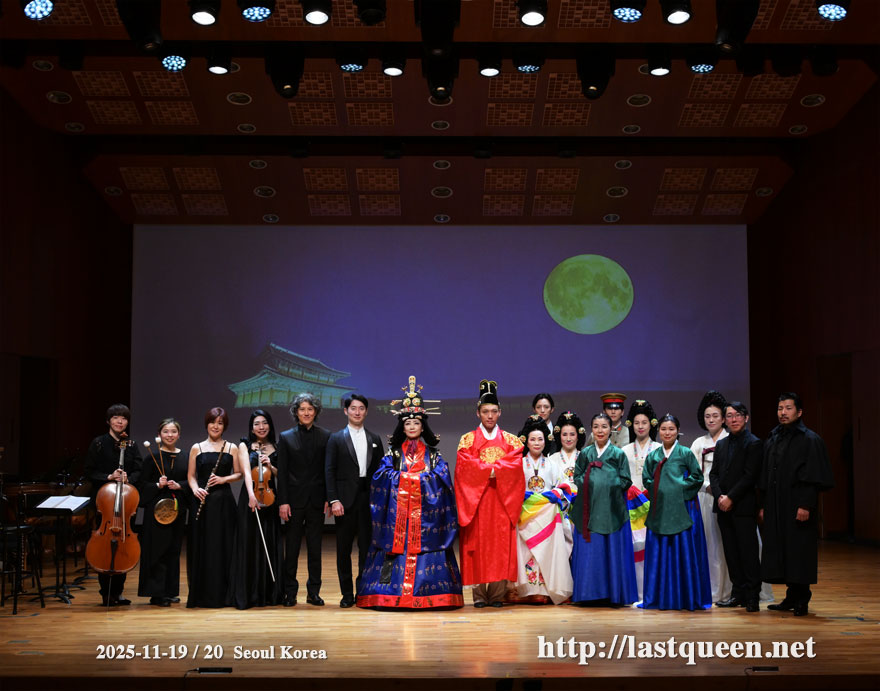
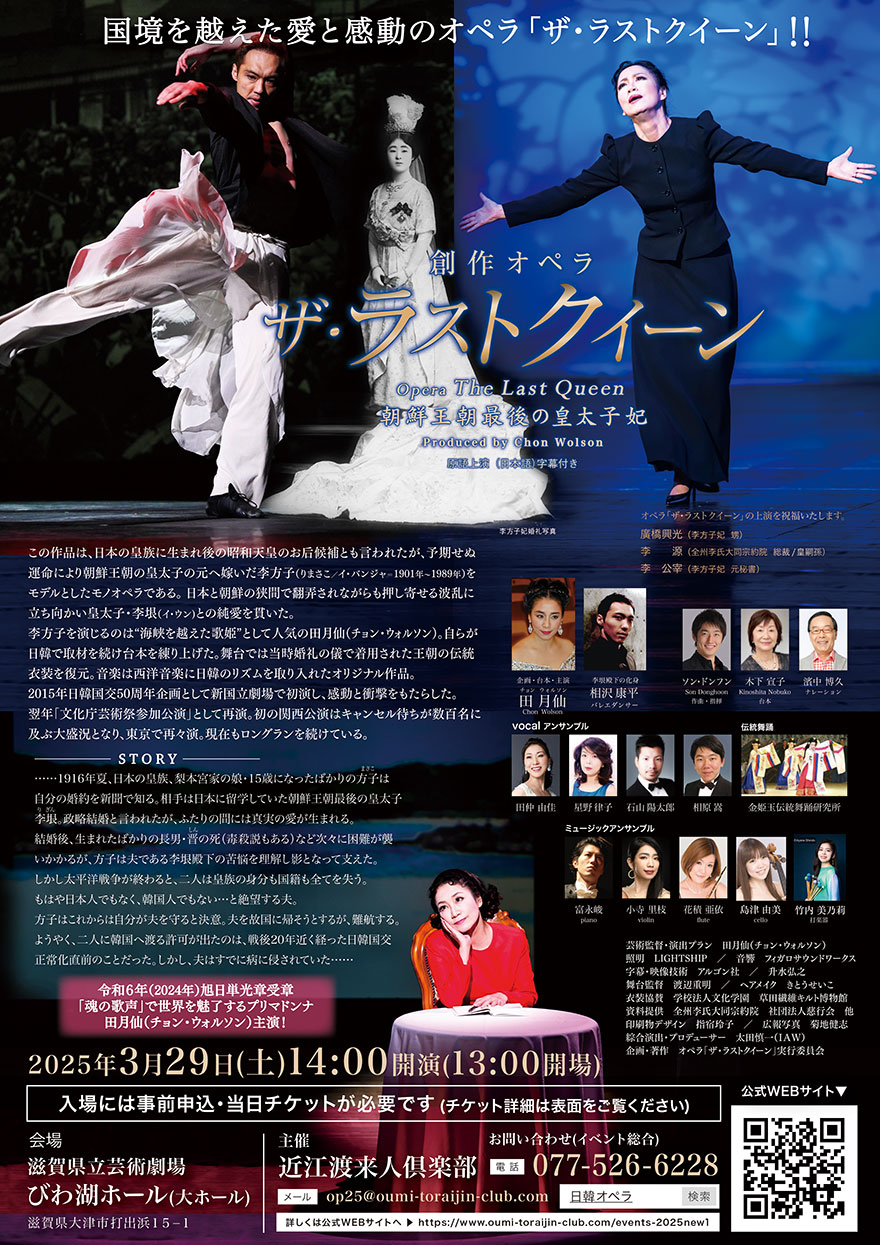
Seoul performance in

19-20 November 2025!


대본 Kinoshita Nobuko・Chon Wolson
작곡 Son Donghoon・Ryugetsu

이방자역 Chon Wolson

전하의 화신(혼) Aizawa Kohei

vocal 앙상블
Kanazawa Kie
Hoshino Ritsuko
Ishiyama yotaro
Aihara Takashi

음악 앙상블
Tominaga Shun piano
Kodera Rie violin
Hanazumi Ai flute
Koshikawa Kazune cello
Takeuchi Minori percussion

Kim Heeok
EMPYamashita
Izumi Yohei

Narration Shin Euisoo


예술 감독 Chon Wolson
무대 감독 Akiyama Takeshi
조명 Akutagawa Kumiko 음향 Aoki Hisashi
자막 영상 Soma Daisuke Matsumoto Humihiko
헤어메이크 Kito Seiko Sakaida Misao
영상제작 IAW 
한국협력 INDECOM  Lee Lees 
나래이션 Hamanaka Hirohisa
연출총감독 Ota Shnichi

Special Thanks 김덕길


주최 오페라「더・라스트 퀸」실행위원회
주관 (사)국제문화공연교류회
주관 IAW.co.ltd
후원 주대한민국일본국대사관
후원 (사)한일친선협회중앙회
지원
협찬
협찬


일시

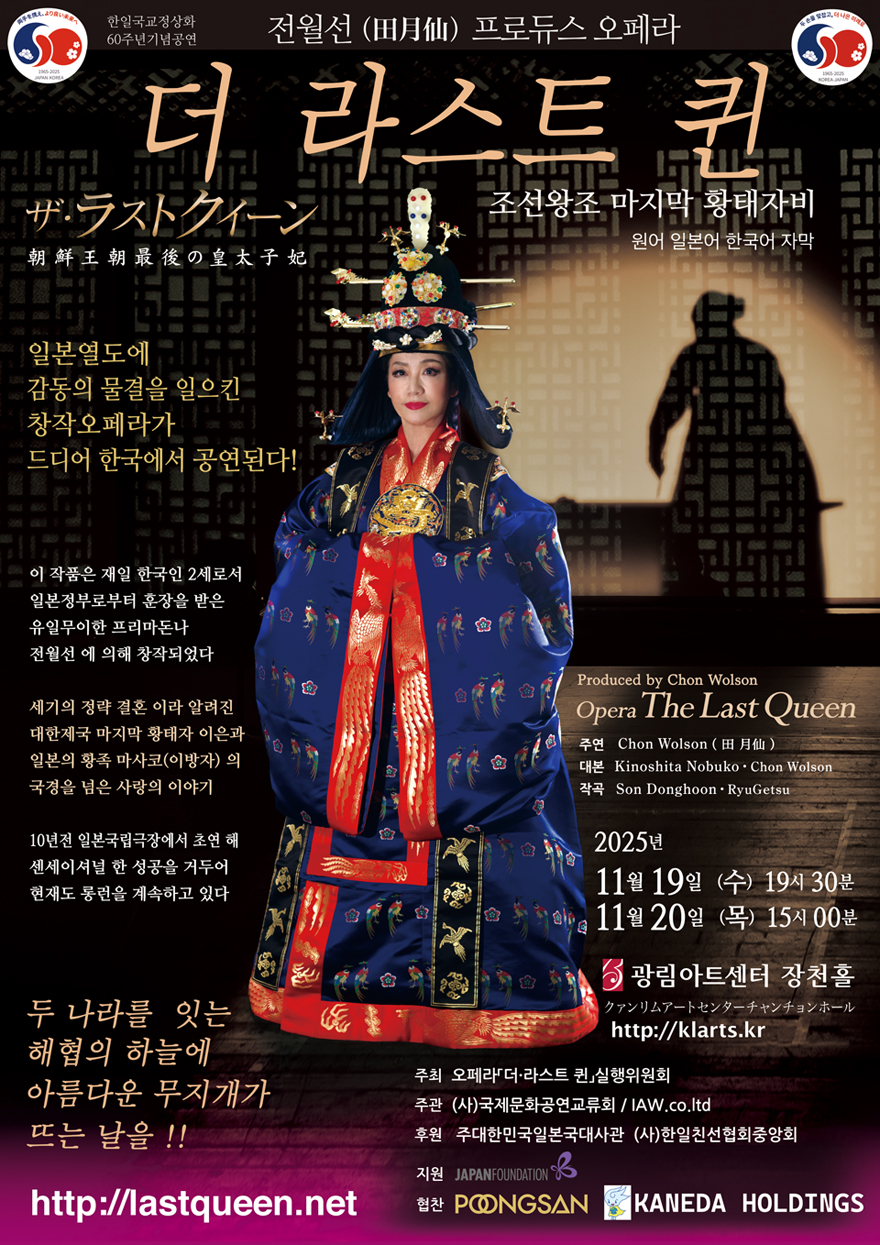
2025년 11월 19일(수)19시 30분
2025년 11월 20일(목)15시 00분

회장

광림아트센터 장천홀 

http://klarts.kr


티켓

티켓 R석 100,000원 /S석 70,000원/A석50,000원 

YES24 1544-6399

문의처


문의 kc0622@naver.com mail@lastqueen.net
phone(사)국제문화공연교류회 02-543-7352 


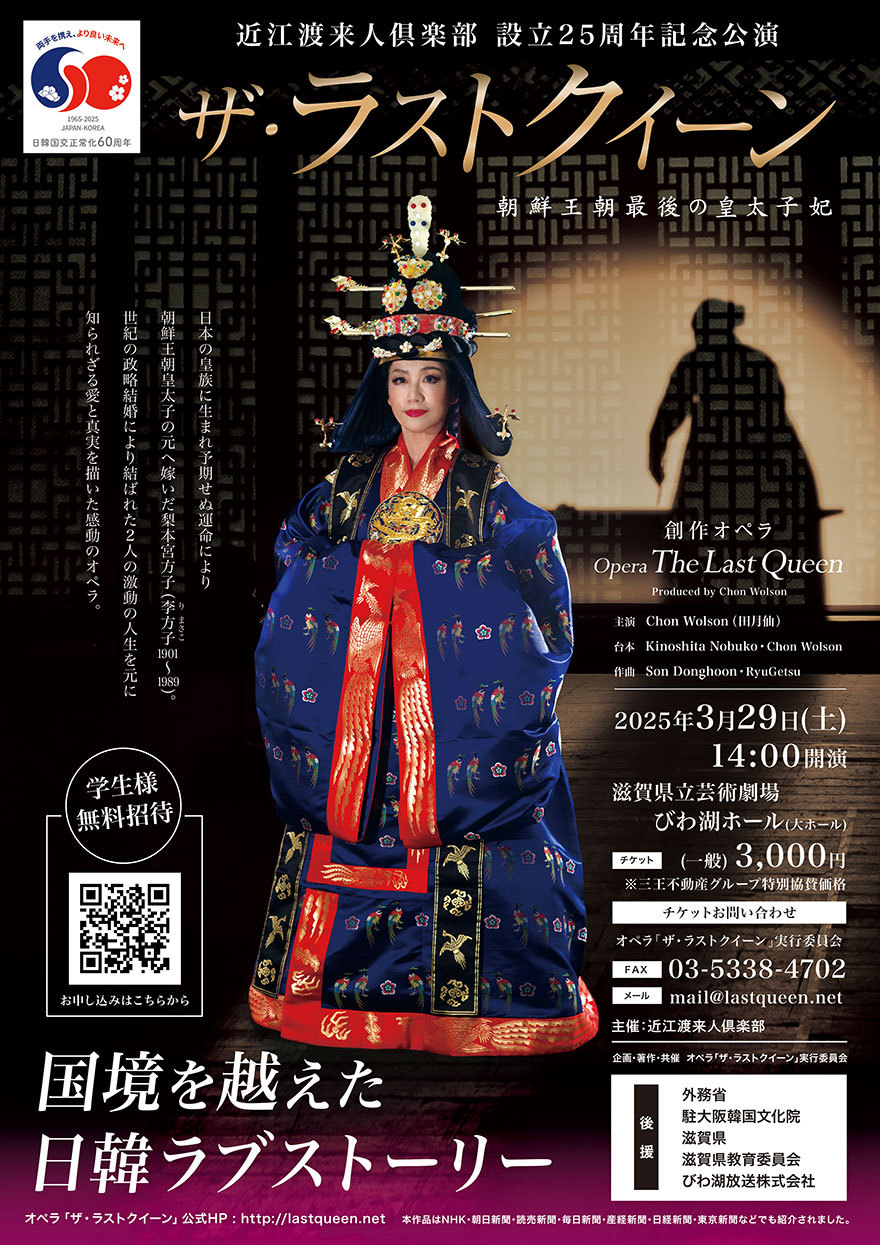
Opera “The Last Queen”

The Chosen Dynasty's last Crown Princess, Yi Bangja

produced by Chon Wolson

Trailer

Brought back by popular demand

Saturday, 29 , March, 2025

Biwako Hall Center , Shiga


Congratulations  

Princess Yi Bangja's nephew

Hirohashi Okimitsu

The Last Queen" is an opera based on my aunt, Lee Bang-ja. I was deeply moved by the opportunity to watch the passionate performances with so many audiences at its premiere at the New National Theatre in Tokyo in October 2015, its re-run at the Agency for Cultural Affairs Arts Festival in Tokyo in 2016, its Osaka performance in 2019, and its Tokyo performances in 2021 and 2022.
I would like to express my gratitude to Tatsukisen, who has worked as a bridge between Japan and Korea, as well as to my co-stars and all those involved. I sincerely hope the performances are a success.


Congratulations
 
  Former Minister of Foreign Affairs
Former Minister of Foreign Affairs
Former Ambassador of the Republic of Korea to Japan
Ambassador of the Republic of Korea to Japan


2015

2016

2019

2021

2022
     

Trailer

Media(TV newspaper)


Overview

Today, June 22, 2015, Japan and the Republic of Korea celebrate 50 years of diplomatic relations, yet one could say that relations between the two countries have never been worse. Still, amidst the stong anti-Japanese attitudes that prevailed in Korea after the war, one women stood out in trying to achieve a reconciliation between the countries. Queen I Bangja (Lee Masako) became a bridge between Korea and Japan. By creating and staging her life as the opera "The Last Queen," we want to re-examine the relationship between Japan and Korea.
The lead role will be played by Chon Wolson, the only singer to have sung before the leaders of Japan, North Korea, and the Republic of Korea (South Korea), and has herself served as a bridge between Japan and Korea.
The team writing the script has been analyzing newly discovered materials, including a handwritten diary, photos, and video recordings.
Also, the production makes use of a restored Korean-style ceremonial wedding costume worn by Princess I Bangja in during her wedding to Crown Prince I Eun, which adds to the uniqueness of the performance.

This work, set in the narrow space of Japan and Korea, is a mono opera based on the life of Yi Bangja (Li Masako, 1901-1989), who devoted herself to peace. The part of Princess Masako Li will be played by Chon Wolson, the prima donna who has been bringing Japan and Korea together through song. A few years back, Princess Masako’s hand-written diary and many of her letters and photographs were discovered, and these are being used as sources to construct the story.
The performance also makes use of the special “chogi” costume warn by Princes Masako at the time of her wedding at the palace of the Chosen Dynasty. The chogi was sent by Japan to the Republic of Korea as a gift in 1990, and it is being housed in the National Palace Museum of Korea. Currently it is not viewable by the public, but with the cooperation of the Educational Foundation Bunka Gakuen), which houses the reproduction created by the Chojun Textile & Quilt Art Museum, a replica for use on stage is being made.
The music for the opera is also original and modern and makes use of Korean and Japanese rhythms. Diva Chon Wolson is committing her body and soul to bringing the untold story of Princess Li Masako to stage. We can expect artistic expression as she gives voice to the Princess's spirit.


Supporters


Okimitsu Hirohashi (Princess I Bangja's nephew)
I Weon (Jeonju Isshi Daedong Imperial Family Association President)
I Gongjae (I Bangja's former secretary)
Bak (Park) Hasun (Director, Jahaenghoe Association慈行会)
Kang Seongsuk (Former Executive Director, Myeonghwi-won 明暉園facility for the handicapped)
Sunao Onuma (President, Educational Foundation Bunka Gakuen)
Kim Sunhi (Soonhi) (Curator, Chojun Textile & Quilt Art Museum)
Fumio Samejima (Chairman Japan Korea Cultural Foundation)
Masatoshi Muto (Former Japanese Special Ambassador to the Republic of Korea/Executive Committee member)


Synopsis

My two beloved homelands
Have good fortune, motherlands. Together, forever


 In the summer of 1916 the barely 15-year-old Masako, the daughter of Imperial family member Prince Nashimoto, learns of her own engagement in the newspaper. Her groom is to be Crown Prince Yi Un of the former Korean Empire. While it was conceived of as a politically strategic marriage, the couple comes to truly love each other. The couple suffers from a string of hardships, including the death (perhaps poisoning) of their first son Shin, but through it all Masako is understanding and supportive of her husband Prince Yi Un. However, with the end of the Pacific War, the couple loses everything, including their royalty and their citizenship. Prince Yi Un dispaires at being neither Korean nor Japanese. Masako, who until then has followed her husband, results to take it on herself to protect him. She tries to get him back to his homeland, but difficulties arise. At long last, the couple receive permission to embark for Korea, almost 20 years after the war and on the eve of the normalization of relations between Japan and Korea. However, the Prince is terribly ill.
Following her husband's death, Masako stays on in Korea, vowing to do everything she can for Japan and Korea. At first she is viewed with cold eyes, but she devotes herself to the welfare of the unfortunate children of Korea. She is eventually called the “Mother (Omoni) of Korea.” She was the last crown princess, the last queen, of the Chosen Dynasty. When she died at age 87, the Korean people sent her off with tears, and her funeral percession stretched for kilometers.

Yi Bangja (Li Masako) 1901-1989

She was born into the Japanese Imperial Family as the daughter of Prince Nashimoto, and had been considered a candidate to marry then-Crown Prince Hirohito (later the Showa Emperor), but in 1920 she married Crown Prince Yi Un of Korea, the heir to the former imperial thrown of Korea, which was now incorporated into Japanese royalty. Following the annexation of Korea by Japan, this marriage was seen as strategic in promoting harmony between Japan and Korea.
However, with Japan's defeat in World War II, the couple lost their imperial status, their Japanese citizenship, and their assets. They originally sought to move to Korea, but were rejected as “Japanese collaborators.” At long last they received a permit to move in 1963, just prior to the normalization of relations between Japan and the Republic of Korea. However, Prince Yi Un was already ill.
Even so, after her husband's death Princess Masako did not return to Japan. Moreover, amidst the prevailing anti-Japanese sentiment swirling in Korea and a less than warm view of her as a Japanese, she contributed to Korean society by putting her energy into the education of handicapped children. Eventually she was accepted and came to be called Korea's “Omoni,” or mother. When she passed away at age 87 she was given a semi-state funeral as Crown Princess, and her percession of greaving Koreans stretched for kilometers.

Chon Wolson and the original opera “The Last Queen”


“The Last Queen” is an original creation that Chon Wolson has been planning for the past ten years, and it is coming to fruition to commemorate the 50th anniversary of the normalization of relations between Japan and the Republic of Korea.

In the more than 30 years since her debut, Chon Wolson has not only performed operatic arias, but also has introduced audiences to songs from Japan and the Korean peninsula, to much critical acclaim. She performs Korean and Japanese songs regularly alongside operatic arias at her recitals. She methodically seeks out songs to do this. She finds songs immersed with history, listens to what people connected with the song have to say, imagines the feelings of the people included in the song, and then gives it her own interpretation.

What motivated her to start seeking out these songs was a Japanese song she was to sing in 1998 when Japanese cultural goods were liberalized in South Korea was forbidden. Before that, she had already uncovered the song “Korei Sanga, Waga Ai,” which led her to seek out other banned songs. Then in 2006, she published her non-fiction book “Aria of the Straits,” drawing on the lives of the people of in the narrow space of Japan and the Korean Peninsula her own impressions. The book received an award, and she followed it up with a history of musical exchange between Japan and Korea called “The Forbidden Songs” (published by Chuo Koron) and another about deep connections between K-pop and Japanese songs called “Distant memories of K-pop” (published by Shogakkan), both of which viewed the two nation’s history from a musical perspective. Even historical witnesses who are usually tight-lipped opened up to Wolson, who has lived a life straddling Japan and the two Koreans.

And this year she carries this work forward to culmination in the original opera “The Last Queen.”

The libretto for “The Last Queen” is based on lost sources that were dug up as well as new information acquired by actually walking around various locations in Japan and Korea in order to paint an accurate picture of Masako Lee. As for the costume, it is being made realistically based on a reproduction of Masako Lee’s actual gown that cost tens of millions of yen to produce following the return of the original gown by the government of Japan to South Korea in 1990. (The original relic is stored in the National Palace Museum of Korea and is closed to the public.) Access to the reproduction was secured with the cooperation of the Education Foundation Bunka Gakuen. The music for the opera is also original and modern and makes use of Korean rhythms and Japanese melodies.

Opera Creation “The Last Queen”
The Chosen Dynasty's last Crown Princess, Yi Bangja

Major staff
Princess I Bangja: Chon Wolson (soprano)
Composer: Son Donghoon and Ryu Getsu
Libretto: Nobuko Kinoshita and Chon Wolson
Production: Kim Su-jin (Theater Shinjuku Ryozanpaku)
Orchestra: NEAR Music Ensemble (Shun Tominaga, piano)


Costume Sponsorship: Educational Foundation Bunka Gakuen, with the cooperation of the Chojun Textile & Quilt Art Museum


Ticket

CALAF.NET
EMAIL


Inquiries:

The Last Queen Executive Committee
http://www.lastqueen.net

Chon Wolson hopes opera will bridge South Korea-Japan ties

JAPAN NEWS The Yomiuri Shimbun


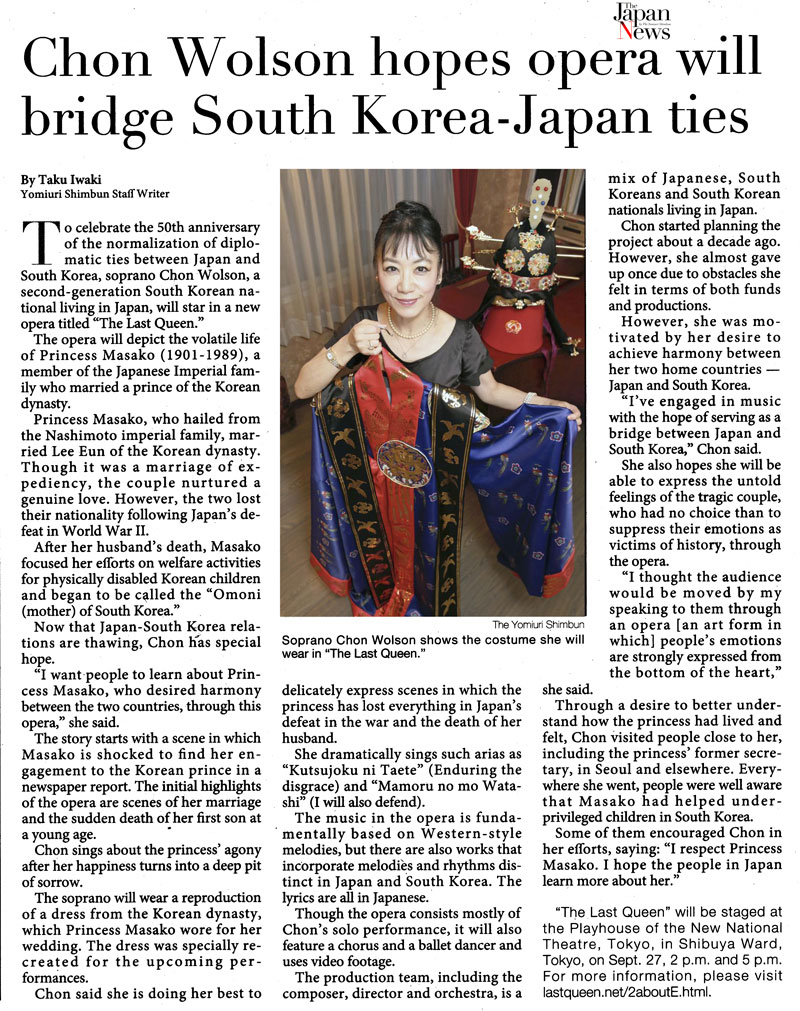
Soprano Chon Wolson shows the costume she will wear in “The Last Queen.”


To celebrate the 50th anniversary of the normalization of diplomatic ties between Japan and South Korea, soprano Chon Wolson, a second-generation South Korean national living in Japan, will star in a new opera titled “The Last Queen.”

The opera will depict the volatile life of Princess Masako (1901-1989), a member of the Japanese Imperial family who married a prince of the Korean dynasty.

Princess Masako, who hailed from the Nashimoto imperial family, married Lee Eun of the Korean dynasty. Though it was a marriage of expediency, the couple nurtured a genuine love. However, the two lost their nationality following Japan’s defeat in World War II.

After her husband’s death, Masako focused her efforts on welfare activities for physically disabled Korean children and began to be called the “Omoni (mother) of South Korea.”

Now that Japan-South Korea relations are thawing, Chon has special hope.

“I want people to learn about Princess Masako, who desired harmony between the two countries, through this opera,” she said.

The story starts with a scene in which Masako is shocked to find her engagement to the Korean prince in a newspaper report. The initial highlights of the opera are scenes of her marriage and the sudden death of her first son at a young age.

Chon sings about the princess’ agony after her happiness turns into a deep pit of sorrow.

The soprano will wear a reproduction of a dress from the Korean dynasty, which Princess Masako wore for her wedding. The dress was specially re-created for the upcoming performances.

Chon said she is doing her best to delicately express scenes in which the princess has lost everything in Japan’s defeat in the war and the death of her husband.

She dramatically sings such arias as “Kutsujoku ni Taete” (Enduring the disgrace) and “Mamoru no mo Watashi” (I will also defend).

The music in the opera is fundamentally based on Western-style melodies, but there are also works that incorporate melodies and rhythms distinct in Japan and South Korea. The lyrics are all in Japanese.

Though the opera consists mostly of Chon’s solo performance, it will also feature a chorus and a ballet dancer and uses video footage.

The production team, including the composer, director and orchestra, is a mix of Japanese, South Koreans and South Korean nationals living in Japan.

Chon started planning the project about a decade ago. However, she almost gave up once due to obstacles she felt in terms of both funds and productions.

However, she was motivated by her desire to achieve harmony between her two home countries — Japan and South Korea.

“I’ve engaged in music with the hope of serving as a bridge between Japan and South Korea,” Chon said.

She also hopes she will be able to express the untold feelings of the tragic couple, who had no choice than to suppress their emotions as victims of history, through the opera.

“I thought the audience would be moved by my speaking to them through an opera [an art form in which] people’s emotions are strongly expressed from the bottom of the heart,” she said.

Through a desire to better understand how the princess had lived and felt, Chon visited people close to her, including the princess’ former secretary, in Seoul and elsewhere. Everywhere she went, people were well aware that Masako had helped underprivileged children in South Korea.

Some of them encouraged Chon in her efforts, saying: “I respect Princess Masako. I hope the people in Japan learn more about her.”

“The Last Queen” will be staged at the Playhouse of the New National Theatre, Tokyo, in Shibuya Ward, Tokyo, on Sept. 27, 2 p.m. and 5 p.m. For more information, please visit lastqueen.net/2aboutE.html.Speech


EMAIL to The Lastqueen